In Part I of this article, I talked about how quantity can create quality in the eyes of the reader, and that thus focusing on quantity first makes more sense as an author. Today I will talk about how quantity can create quality in the hands of the creator, making a focus on quantity a necessity for the successful author.
Yesterday I talked briefly about the difference between beginnings, middles and ends and reflected a little on what skills I feel I posses in each of them (lots, some and almost none respectively). Today I am going to start by looking at each of these in a little more depth – what exactly are the skills needed in each of these stages and how well do I compare to what I aspire to?
Beginnings are easy and fun. They’re really just ideas, free flowing and co-inspiring. I have lots of ideas... almost everyone who considers themselves to be a creator does. They may not be good ideas and I may be able to improve my ability to select which ideas are most valuable for a given purpose and I would like to improve on my speed with generating ideas within a context, but for the most part I’m happy with my skills when it comes to beginnings.
Middles are all about putting in the time to create the content and solving issues as they come up. Here I think I need more work, specifically with the discipline needed to continue coming back to the same project to continue work after it has stopped being exciting. I need to learn to push myself to keep going even if the work no longer looks like what I imagined it to be and I cannot yet see what it will become. To believe in what I’ve created already when it looks like I am further from being finished than when I started. I suspect I will always have more to learn about various methods I can use to fix what I am creating so that the result is cleaner as well, and I suspect there will be different tricks in each medium, but for the most part what I need is confidence.
Finally, we come to endings. This is the part of creative projects that I am worst at. As I’ve said before, in over a decade of making games, I’ve only finished one of my own initiative. I’ve started loads... at least two a year... but none of those have ever become complete. While much of the reason I’ve finished so few is because I’ve given up in the middle, I still know that it is the endings that I fear the most. I do not think I know when to end, nor how to end well. Even in my professional work I lose focus at the ends of projects, when tweaks still need to be made, but larger changes no longer have a place.
And that’s it. That is the state of my skills when it comes to creating things I care about. Except it is not ‘it’, at least not completely. Even once a project is finished, an independent creator’s work is not done. In order for a work to connect with an audience, there must be an audience for it to connect to. This is the whole world of publishing and advertising, and it is a world that I am completely lost in. I have no idea what the best things to do here are, and I generally feel a little embarrassed to ask someone else to look at what I’ve created. I really suck at this part of project; case in point, I doubt more than a few people are ever going to read this.
So how can I improve? How can I learn the skills that I am missing? I know that I learn best through reading, thinking and talking. And then, finally, practicing. When it comes to creating finished projects, I’ve read many books, I’ve thought many thoughts and I’ve talked to many experts. What I haven’t done, is practice. I will learn the most by experiencing all parts of the creative process multiple times, not just the first few over and over, or all of them spread over a decade. The more projects I can finish (and be satisfied with), the better. This sounds like quantity over quality again (though quality is still important).
All this is to say that as an author I shouldn’t let myself get bogged down in concerns of quality, especially if these concerns are interfering with my ability to produce quantity. It’s not that I should ignore quality entirely – I always want to do my best – but giving up on something because the quality isn’t perfect isn’t really worth it. If I finish something that is less than my best, I can later build on it both in terms of my skill and in terms of the value within it. If I don’t finish something that is less than my best then I am left with nothing. And nothing is certainly less than something.
Any audience worth having will be willing to let me get better, but they won’t wait around for me to create content if I never let them see anything. And the most important audience isn’t external – it’s the internal one which already sees everything anyways.
Tuesday, 3 May 2011

Sunday, 1 May 2011
The Problem with Perfection
Yesterday I talked about how perfection in a created work is an impossibility. Today I am looking at what I consider to be the three problems with this myth known as perfection. The first problem is the recourse to starting over from scratch, the second the temptation to tinker and thirdly is the false expectation of adulation. These are really problems tied to beginnings, middles and ends respectively.
At the start of any project, the possibilities are ripe with potential. Any idea seems like it could have a place, any structure could work. There is no reality to get in the way of creativity. There is no practicality to get in the way of imagination. This is the part of a project where everything always goes right. Because there is as of yet no thing, there is nothing that can go wrong. Having complete creative freedom and the experience of everything going smoothly is an absolutely wonderful feeling. Beginnings are easy to master, and very desirable to repeat. Any time something doesn’t work down the line of a project, it is very tempting to toss the lot and go back to the time when everything was perfect; the beginning. This is the first problem with the expectation of perfection. The only time when everything can be perfect is when we have nothing, so it’s very tempting to continue having nothing for as long as possible.
But being creative means at some point creating something. I sometimes wish I was merely someone who liked having ideas but what I feel driven to do is create. At some point I need to put pen to paper or cursor to screen and start creating content. And at some point, something is going to go wrong. Two pieces of what I am creating are going to work in isolation, but there will be something missing when I try to mesh them.
If I resist the temptation to throw out my work, to assume that I could have created flawlessly, then I need to face the reality of a current imperfection. But because I can see the imperfection, I know I can fix it. I may not know how, but as long as I’m resolved to make it work, I know I can find a way. This is really what the meat of the creative process is. Creating many individual parts and pounding them together into some greater shape. This is the middle, and it can go on for a long time. In fact, it can go on forever.
For a work to be finished all the pieces need to exist and they need to all fit together. Preferably, they need to fit together as close to perfectly as possible. Because I am intimately involved with my creation, I will always know its flaws. A piece may not be structured so that it fits perfectly into the space I’ve provided. Two ideas may not flow correctly into one another. I may be inspired by a new piece that could solve many problems in the work and add only a few new ones. And I will also continuously be finding new problems, new places where my work is not quite perfect.
Because the middle of a work is all about finding the problems with it and fixing them, it is very important for the creator to develop skills in this area. It is very important for the creator to believe that any problem they can find can be fixed. If we did not believe this we would throw our work out to start again, to try to create once without needing to recourse to cleanup. But because we believe fix thing and because we always can see mistakes, we know that a work is never done as well as we could do it, given just a little more time.
This is the second problem with perfection. During the middle of a project, we can always get just a little closer to perfection. And as long as we are trying to get closer to this goal, we will never be done. So how do we finish? How do we actually manage to make something that we can release to the wilds of the world, knowing that there was just a few more things to fix to make it the creation in our dreams? I think there are really three ways.
In the professional world of people being paid to create, the way that projects get finished is through externally imposed deadlines. At some point, the people paying for your work come along and take it away from you whether or not you think it is finished. You need to step back, throw up your hands and say “I did my best”. Even here, it’s not unknown for creations to be late. The creator is unwilling to let go so early. They can see all the flaws and they can point them out to the publisher and make convincing arguments for how they can all be fixed. But still, at some point, the publisher or the customer will demand something that the creator is willing (though perhaps only through gritted teeth) to call finished. Or the publisher may just stop paying for it and the creator will be out of work. Given this choice, most creators will be willing to let go of their still imperfect children.
The second way that creators finish work is through delusion. In the face of being unwilling to release something imperfect and feeling the need to finish it is possible to ignore the truth of imperfection. In a desperate attempt to get something out into the world, a creator may create a temporary insanity in themselves and decide that what they’ve done is, in fact, perfect. That any flaws are merely figments of their imaginations because they are ‘too close to the work’. That finally, they may release their masterpiece out into the world. This is a feeling of absolute jubilation. And it is this joyous liberation which is the third problem with perfection.
If I believe that something I’ve created is perfect and I show it to others under this assumption, then my expectation is that they, to, should see the beauty of my perfection. And if they fail to shower me with adulation, then there is obviously something wrong with them. As more and more people do not express complete amazement, I begin to feel disappointed. Some people may even point out flaws. Depending on how honest I am with myself, I will either continue to assume no-one else in the world knows what they are talking about, or admit that I was deceiving myself. In either case, it is likely that I will decide to stop creating, either because the world is not ready for my genius, or because the revelation that I am in truth imperfect and that I was lying to myself is such a huge crash that I decide the risk of this disappointment isn’t worth future exposure. This is why I stopped writing poetry for many years.
However, if one is willing to admit that perfection is impossible, then all three of these problems of perfection can be avoided. It can be hard, and finding a balance between striving for perfection and being willing to never succeed is draining, but in the end, if you want to finish your creations, this is a hurdle that must be overcome. But I still haven’t said how to finish things without an external deadline and without delusion. I did say there were three ways, and it is necessary to finish if we are going to call ourselves creators.
The third way of finishing is actually fairly obvious. It’s the internally imposed deadline and it’s very hard to achieve. You need a lot of discipline to be able to accomplish this. I’ve been making computer games for over a decade, and I’ve only finished one through an internally imposed deadline (and a very small one at that). I know a lot of people who claim they can’t do this whatsoever, and that’s why they work for other people rather than for themselves. But I believe it is a skill that can be learned. All you need is practice. Practice such as committing to writing a blog every day and seeing how long you can keep going. I hope.
At the start of any project, the possibilities are ripe with potential. Any idea seems like it could have a place, any structure could work. There is no reality to get in the way of creativity. There is no practicality to get in the way of imagination. This is the part of a project where everything always goes right. Because there is as of yet no thing, there is nothing that can go wrong. Having complete creative freedom and the experience of everything going smoothly is an absolutely wonderful feeling. Beginnings are easy to master, and very desirable to repeat. Any time something doesn’t work down the line of a project, it is very tempting to toss the lot and go back to the time when everything was perfect; the beginning. This is the first problem with the expectation of perfection. The only time when everything can be perfect is when we have nothing, so it’s very tempting to continue having nothing for as long as possible.
But being creative means at some point creating something. I sometimes wish I was merely someone who liked having ideas but what I feel driven to do is create. At some point I need to put pen to paper or cursor to screen and start creating content. And at some point, something is going to go wrong. Two pieces of what I am creating are going to work in isolation, but there will be something missing when I try to mesh them.
If I resist the temptation to throw out my work, to assume that I could have created flawlessly, then I need to face the reality of a current imperfection. But because I can see the imperfection, I know I can fix it. I may not know how, but as long as I’m resolved to make it work, I know I can find a way. This is really what the meat of the creative process is. Creating many individual parts and pounding them together into some greater shape. This is the middle, and it can go on for a long time. In fact, it can go on forever.
For a work to be finished all the pieces need to exist and they need to all fit together. Preferably, they need to fit together as close to perfectly as possible. Because I am intimately involved with my creation, I will always know its flaws. A piece may not be structured so that it fits perfectly into the space I’ve provided. Two ideas may not flow correctly into one another. I may be inspired by a new piece that could solve many problems in the work and add only a few new ones. And I will also continuously be finding new problems, new places where my work is not quite perfect.
Because the middle of a work is all about finding the problems with it and fixing them, it is very important for the creator to develop skills in this area. It is very important for the creator to believe that any problem they can find can be fixed. If we did not believe this we would throw our work out to start again, to try to create once without needing to recourse to cleanup. But because we believe fix thing and because we always can see mistakes, we know that a work is never done as well as we could do it, given just a little more time.
This is the second problem with perfection. During the middle of a project, we can always get just a little closer to perfection. And as long as we are trying to get closer to this goal, we will never be done. So how do we finish? How do we actually manage to make something that we can release to the wilds of the world, knowing that there was just a few more things to fix to make it the creation in our dreams? I think there are really three ways.
In the professional world of people being paid to create, the way that projects get finished is through externally imposed deadlines. At some point, the people paying for your work come along and take it away from you whether or not you think it is finished. You need to step back, throw up your hands and say “I did my best”. Even here, it’s not unknown for creations to be late. The creator is unwilling to let go so early. They can see all the flaws and they can point them out to the publisher and make convincing arguments for how they can all be fixed. But still, at some point, the publisher or the customer will demand something that the creator is willing (though perhaps only through gritted teeth) to call finished. Or the publisher may just stop paying for it and the creator will be out of work. Given this choice, most creators will be willing to let go of their still imperfect children.
The second way that creators finish work is through delusion. In the face of being unwilling to release something imperfect and feeling the need to finish it is possible to ignore the truth of imperfection. In a desperate attempt to get something out into the world, a creator may create a temporary insanity in themselves and decide that what they’ve done is, in fact, perfect. That any flaws are merely figments of their imaginations because they are ‘too close to the work’. That finally, they may release their masterpiece out into the world. This is a feeling of absolute jubilation. And it is this joyous liberation which is the third problem with perfection.
If I believe that something I’ve created is perfect and I show it to others under this assumption, then my expectation is that they, to, should see the beauty of my perfection. And if they fail to shower me with adulation, then there is obviously something wrong with them. As more and more people do not express complete amazement, I begin to feel disappointed. Some people may even point out flaws. Depending on how honest I am with myself, I will either continue to assume no-one else in the world knows what they are talking about, or admit that I was deceiving myself. In either case, it is likely that I will decide to stop creating, either because the world is not ready for my genius, or because the revelation that I am in truth imperfect and that I was lying to myself is such a huge crash that I decide the risk of this disappointment isn’t worth future exposure. This is why I stopped writing poetry for many years.
However, if one is willing to admit that perfection is impossible, then all three of these problems of perfection can be avoided. It can be hard, and finding a balance between striving for perfection and being willing to never succeed is draining, but in the end, if you want to finish your creations, this is a hurdle that must be overcome. But I still haven’t said how to finish things without an external deadline and without delusion. I did say there were three ways, and it is necessary to finish if we are going to call ourselves creators.
The third way of finishing is actually fairly obvious. It’s the internally imposed deadline and it’s very hard to achieve. You need a lot of discipline to be able to accomplish this. I’ve been making computer games for over a decade, and I’ve only finished one through an internally imposed deadline (and a very small one at that). I know a lot of people who claim they can’t do this whatsoever, and that’s why they work for other people rather than for themselves. But I believe it is a skill that can be learned. All you need is practice. Practice such as committing to writing a blog every day and seeing how long you can keep going. I hope.
The Myth of Perfection
It is so easy to fall into the trap of trying to achieve perfection. Of judging my efforts at creation to be not worthy of being placed where others can see them, at least ‘not yet’. Often, it is only an externally imposed deadline that forces me to ever show something I’ve done. But I’m beginning to think that perfection is a myth. That perfection is, in fact, unattainable. The basic problem with perfection is that it is subjective. What I consider to be the ‘perfect’ meal is different from what you consider to be the ‘perfect’ meal. But this doesn’t seem to be much of a problem. Just because we can’t both have the same meal and have it be perfect for both of us, doesn’t mean that I can’t have the perfect meal ‘for me’...
Actually, I think it does mean this. The perfect meal doesn’t merely vary with the person, it also varies with that person’s mood. And it varies with other parts of a person’s experience; on a hot day I have a different perfect meal than on a cold day. But I should still be able to have the perfect meal for me, right now. The meal that is perfect for me in the moment that I have it. Sure. Maybe. But as soon as I’ve had it, the perfect meal for me will have changed. The perfect meal within the context of having just eaten the meal that was perfect for me at the time that I had it is different than the meal I just had.
This may sound like ‘just semantics’, and at other times this assertion may be true of arguments I make (I do so love those semantics). However, the problem is that we aren’t talking about the perfect meal. We aren’t talking about food. We aren’t talking about an experiential event. Instead, we are talking about the creative process. As an event, a perfect meal can be perfect the moment it starts or the moment it ends (or possibly both) and be remembered for its perfection. As a process, creativity is ongoing. It ends when the creator says it ends. Or not even then; a creator can change their mind and go back to viewing the process as unfinished. Further, finishing a creative process takes time and effort. There is a logistical problem to finishing a work. There is a process of placing the creation in a context where it can find an audience. And as this process of ‘publishing’ is non-instantaneous, there is always the possibility of finding imperfection in the creation during the process of ‘publishing’.
Where does this imperfection come from? Part of it is that we are always changing who we are in terms of our mood, our environment and our desires. But as creators we are also different after having gone through a creative process in one very important way that directly reveals imperfection in our creations. When we are creating, we are learning about the creative process. We are finding new challenges to surmount in our work and figuring out how to surmount them. This is true of any flow activity; we maintain our own involvement by finding challenges that are neither too easy (boring) nor too hard (frustrating) and then learning how to deal with this new challenge.
I argue that learning how to overcome a challenge is a recipe for imperfection. The process of learning is experimental in nature. In order to learn, we try things out to see if they work. Then we observe what we’ve done (or are doing) to see what is working and what is not. This second part is very important; in order to learn, something has to be not working. We need some behaviour or process to correct. We need to have failed in some way, to have made mistakes, to have been imperfect. If we do not have these experiences of improvement, then we haven’t chosen a good challenge for our flow experience. We have chosen something we already know how to master. We have chosen a process that is boring and we won’t choose to repeat it.
Actually, I think it does mean this. The perfect meal doesn’t merely vary with the person, it also varies with that person’s mood. And it varies with other parts of a person’s experience; on a hot day I have a different perfect meal than on a cold day. But I should still be able to have the perfect meal for me, right now. The meal that is perfect for me in the moment that I have it. Sure. Maybe. But as soon as I’ve had it, the perfect meal for me will have changed. The perfect meal within the context of having just eaten the meal that was perfect for me at the time that I had it is different than the meal I just had.
This may sound like ‘just semantics’, and at other times this assertion may be true of arguments I make (I do so love those semantics). However, the problem is that we aren’t talking about the perfect meal. We aren’t talking about food. We aren’t talking about an experiential event. Instead, we are talking about the creative process. As an event, a perfect meal can be perfect the moment it starts or the moment it ends (or possibly both) and be remembered for its perfection. As a process, creativity is ongoing. It ends when the creator says it ends. Or not even then; a creator can change their mind and go back to viewing the process as unfinished. Further, finishing a creative process takes time and effort. There is a logistical problem to finishing a work. There is a process of placing the creation in a context where it can find an audience. And as this process of ‘publishing’ is non-instantaneous, there is always the possibility of finding imperfection in the creation during the process of ‘publishing’.
Where does this imperfection come from? Part of it is that we are always changing who we are in terms of our mood, our environment and our desires. But as creators we are also different after having gone through a creative process in one very important way that directly reveals imperfection in our creations. When we are creating, we are learning about the creative process. We are finding new challenges to surmount in our work and figuring out how to surmount them. This is true of any flow activity; we maintain our own involvement by finding challenges that are neither too easy (boring) nor too hard (frustrating) and then learning how to deal with this new challenge.
I argue that learning how to overcome a challenge is a recipe for imperfection. The process of learning is experimental in nature. In order to learn, we try things out to see if they work. Then we observe what we’ve done (or are doing) to see what is working and what is not. This second part is very important; in order to learn, something has to be not working. We need some behaviour or process to correct. We need to have failed in some way, to have made mistakes, to have been imperfect. If we do not have these experiences of improvement, then we haven’t chosen a good challenge for our flow experience. We have chosen something we already know how to master. We have chosen a process that is boring and we won’t choose to repeat it.
Saturday, 30 April 2011
Quantity versus Quality, Part I
I’ve long held the belief that quality is far more important than quantity, at least as far as media goes. I only have time for a few media experiences, so I want those to be the best they can be. But I’m now thinking that this general rule breaks down when I am the author rather than the audience.
I’ve noticed something with content on the web. While 90% of everything may be crap, when enough crap gets put into the same place and follows the same themes, it stops being crap. Long running web comics may start out terrible, but somehow they transform into something worthwhile. I may still look at the end result and be dissatisfied, but every web comic that has passed a thousand strips has a fan base. I think this has to do with quality being found in depth, and the indirect relationship between quantity (within a common frame) and depth.
I define depth as the number of connections in a system, while complexity is the number of individual nodes. While it is possible to have a very deep system that is not complex, it is much harder to have a very complex system that is not also deep. If a system has only a handful of nodes but they are all connected to everything else we have a non-complex system that is very deep. Conversely, if we have a system that has only one connection per node, but has lots of nodes, then there may not be much depth per node but the total complexity level still leads to some depth overall. Depth is desirable for creating meaning, and while it is often preferable to have depth without complexity, this is not a hard rule. Depth through complexity is better than no depth at all.
Now complexity is interesting. Systems that are constantly modified tend towards complexity. When modifying a system, more time is usually spent adding to it than removing from it. This is especially true of narrative frameworks that exist in the mind of a reader. Even telling the reader that “it was all a dream” doesn’t remove complexity. In other words, any narrative system that is extended over a long period of time will grow in complexity. And as a narrative system grows in complexity, so does its increase in depth.
In other words quantity seems to trump quality. Here it’s not that quantity is better than quality. Quality is certainly more important. Rather, we can see that quantity often leads to some degree of quality. The inverse cannot be said to be true; quality doesn’t create quantity. Further, in most cases having both quality and quantity is more desirable than just having quality. This suggests that focusing on quantity first is far more important – even if quality is the long term goal.
This property of narrative contexts doesn’t necessarily extend to non-narrative contexts, such as this present essay. However, I believe there is another fundamental way that quantity is more important than quality in any work in which one plays the role of author. I will examine what this way is in Part II.
I’ve noticed something with content on the web. While 90% of everything may be crap, when enough crap gets put into the same place and follows the same themes, it stops being crap. Long running web comics may start out terrible, but somehow they transform into something worthwhile. I may still look at the end result and be dissatisfied, but every web comic that has passed a thousand strips has a fan base. I think this has to do with quality being found in depth, and the indirect relationship between quantity (within a common frame) and depth.
I define depth as the number of connections in a system, while complexity is the number of individual nodes. While it is possible to have a very deep system that is not complex, it is much harder to have a very complex system that is not also deep. If a system has only a handful of nodes but they are all connected to everything else we have a non-complex system that is very deep. Conversely, if we have a system that has only one connection per node, but has lots of nodes, then there may not be much depth per node but the total complexity level still leads to some depth overall. Depth is desirable for creating meaning, and while it is often preferable to have depth without complexity, this is not a hard rule. Depth through complexity is better than no depth at all.
Now complexity is interesting. Systems that are constantly modified tend towards complexity. When modifying a system, more time is usually spent adding to it than removing from it. This is especially true of narrative frameworks that exist in the mind of a reader. Even telling the reader that “it was all a dream” doesn’t remove complexity. In other words, any narrative system that is extended over a long period of time will grow in complexity. And as a narrative system grows in complexity, so does its increase in depth.
In other words quantity seems to trump quality. Here it’s not that quantity is better than quality. Quality is certainly more important. Rather, we can see that quantity often leads to some degree of quality. The inverse cannot be said to be true; quality doesn’t create quantity. Further, in most cases having both quality and quantity is more desirable than just having quality. This suggests that focusing on quantity first is far more important – even if quality is the long term goal.
This property of narrative contexts doesn’t necessarily extend to non-narrative contexts, such as this present essay. However, I believe there is another fundamental way that quantity is more important than quality in any work in which one plays the role of author. I will examine what this way is in Part II.
Friday, 29 April 2011
Cut from my Dissertation
Preface
I find that I can fairly easily write a thousand words on any subject that interests me, though sometimes (and I have no way to tell this before writing) I’ll only be able to write a few hundred words while other times I’ll write two thousand. But writing more than three or four thousand words is really hard.
My Masters dissertation needed to be 12 to 18 thousand words long.
When presented with needing to write a longer essay I chop the task into several interconnected pieces. While I effectively did the same thing with my dissertation, three or four interconnected pieces just wasn’t going to cut it. However, almost everything I write gives me ideas for other things I would like to write (creativity is not a limited resource). So, having written several interconnected sections, I was able to find new things to write that were connected to one or two of the pieces already written.
At first, I chose each next thing to write as I sat down to write it, based only on what most interested me in that moment. As I got closer to my target I realised that some of my sections were becoming very divergent, so I started trying to ensure that I wrote towards connecting the various ideas and creating a flow through the whole. Still, in the end I was left with one major tangent... but by that time I was already just over 18 thousand words. So I cut the tangent and polished what was left.
But I still like the tangent. So I’m presenting it here.
The context of this tangent is that I have defined games as ‘play within a finite system’ and a finite system as being able to be wholly described as a list of possible states (though this list may be impractically long). I also made the claim that goals are inherent to play; play is active, as opposed to reactive or passive, and all actions are directed towards an intention. In other words, by being active, play encompasses intentions – and goals are just a particular ‘look’ at intentions.
The Cut
Before moving on to other values to compare my new definition with, I would like to touch on one possible objection to what I’ve outlined above. When we speak of goals within the context of a game, we generally refer to ‘the’ goal, not ‘one of many’ goals. Considering a game as ‘play within a finite system’ there is no insistence within the game that players have a particular goal – they are welcome to bring any goal they want to play with in order to join this notion of a game. Surely all players within a game must have the same goal in order for the game to be a game and not many different games? Further, if a player is within a finite system and accomplishes one goal only to adopt another, then they must be playing a different game than the one they initially sat down to play? Where do these differences exist within my definition?
In this case, rather than find the singular goal within my definition, I will step back and contend that it is only certain types of games that must have singular goals. For instance, in our discussion of Myers’ definition we have already seen that different players have different goals when playing a role playing game. While this can cause break down in the successful play of the game, in the cases where all players are able to pursue their individual goals within the game the game works well; more importantly, it certainly is a game. In addition, something not mentioned in our discussion before is that the goals of a role player are mutable – in different situations the same player may be pursuing different goals. But even though the player is changing goals, they are still playing the same game.
Which begs the question, if not all games are necessarily single goaled, what is the type of game that must have the same goal for all players and how does my definition contend with those games? Almost all contests fall into the category of having the same goals between players. The reason they need to have the same goals is because the challenge of a contest is to beat the other players – in order for the play to have the possibility of failure, the other players must be trying to attain the same results you are. While there are some contest like games that have different goals between players, these are the exception... and even then, the differing goals will be predictably similar between instances of the same game. In all these games the goals are codified by rules and failure to try to attain the goal means that the other players will not be appropriately challenged. Upon finding out that their opponent has not been following this rule they will feel cheated. How is it that the goal of these games has moved from ‘play’ to ‘rules’ and how does ‘finite system’ embody the rule of trying to achieve a goal?
First of all, it is important to observe that not following this rule is not necessarily the same as not following other rules. If I am not trying to win, you will only feel cheated if you feel that you are no longer having an appropriate challenge from your play. If ten people are racing, but one of them is pursuing a different goal that does not interfere, then the other nine will still be challenged by each other. All (including the differently goaled player) are still in the race. Likewise, if we are only playing a two player game, and my different goal does interfere with your attempt to win, but the interference neither makes your attempt too hard nor too easy, then it is likely that you will not feel cheated and that the game will go on. Whether or not it is still the same game is a point of contention, but I’m fairly certain that the resolution of this question must be subjective.
Secondly, while the goal may exist within the rules, its pursuit must still exist solely in the play. A rule may tell a player that in order to play a game they must attempt to change the state of the game to a particular condition, but the rules cannot be responsible for enforcing the intent of the player. Not only are the rules inert but intent is ultimately unknowable by any but the intender. It is only the player who can be unrealistic in their optimism or who acknowledges failure that can choose their intended outcomes. In other words, while goals may be found within rules, they are only ever pursued within play.
In terms of locating the rule coding for a goal within a finite system, I would like to suggest that any game that includes a rule of a particular goal contains a global state within which that goal is active. For instance, in a race, there is a state which describes a player as trying to win the race. However, the alternative state of not trying to win the race does not exist within the finite system – the finite system may refer to the state but it does not contain the state. At first, this may seem objectionable. Surely any state the finite system observes must be contained within the finite system?
To help with understanding how this can be, let me propose a simple game and then list the states that are contained within the game. The rules of the game are that you roll a dice until you roll any number other than a six. No goal within these rules. (Though note that in order to play you will need to have a goal – you can’t help but have a goal if you are going to be within the emotion of play. You can try to trick the system by trying to not having a goal while playing this game, but you will quickly observe that your optimism that you can do that is highly unrealistic.)
Now let me list the states of this simple game:
1) You are rolling the die
2) The die is showing a six
And that is it. There are no states within the game that include any of the other values that could be shown on the die. Each of the other values that could be shown are states that the die could be in, and the game certainly references the state of the die, but the only state of the die that is contained within the game is the one where it shows a six. From this it is not a stretch to see that one of the states that could be tracked within a game is the intent of the player, even if the only valid state for the players’ intent was trying to win the game.
I find that I can fairly easily write a thousand words on any subject that interests me, though sometimes (and I have no way to tell this before writing) I’ll only be able to write a few hundred words while other times I’ll write two thousand. But writing more than three or four thousand words is really hard.
My Masters dissertation needed to be 12 to 18 thousand words long.
When presented with needing to write a longer essay I chop the task into several interconnected pieces. While I effectively did the same thing with my dissertation, three or four interconnected pieces just wasn’t going to cut it. However, almost everything I write gives me ideas for other things I would like to write (creativity is not a limited resource). So, having written several interconnected sections, I was able to find new things to write that were connected to one or two of the pieces already written.
At first, I chose each next thing to write as I sat down to write it, based only on what most interested me in that moment. As I got closer to my target I realised that some of my sections were becoming very divergent, so I started trying to ensure that I wrote towards connecting the various ideas and creating a flow through the whole. Still, in the end I was left with one major tangent... but by that time I was already just over 18 thousand words. So I cut the tangent and polished what was left.
But I still like the tangent. So I’m presenting it here.
The context of this tangent is that I have defined games as ‘play within a finite system’ and a finite system as being able to be wholly described as a list of possible states (though this list may be impractically long). I also made the claim that goals are inherent to play; play is active, as opposed to reactive or passive, and all actions are directed towards an intention. In other words, by being active, play encompasses intentions – and goals are just a particular ‘look’ at intentions.
The Cut
Before moving on to other values to compare my new definition with, I would like to touch on one possible objection to what I’ve outlined above. When we speak of goals within the context of a game, we generally refer to ‘the’ goal, not ‘one of many’ goals. Considering a game as ‘play within a finite system’ there is no insistence within the game that players have a particular goal – they are welcome to bring any goal they want to play with in order to join this notion of a game. Surely all players within a game must have the same goal in order for the game to be a game and not many different games? Further, if a player is within a finite system and accomplishes one goal only to adopt another, then they must be playing a different game than the one they initially sat down to play? Where do these differences exist within my definition?
In this case, rather than find the singular goal within my definition, I will step back and contend that it is only certain types of games that must have singular goals. For instance, in our discussion of Myers’ definition we have already seen that different players have different goals when playing a role playing game. While this can cause break down in the successful play of the game, in the cases where all players are able to pursue their individual goals within the game the game works well; more importantly, it certainly is a game. In addition, something not mentioned in our discussion before is that the goals of a role player are mutable – in different situations the same player may be pursuing different goals. But even though the player is changing goals, they are still playing the same game.
Which begs the question, if not all games are necessarily single goaled, what is the type of game that must have the same goal for all players and how does my definition contend with those games? Almost all contests fall into the category of having the same goals between players. The reason they need to have the same goals is because the challenge of a contest is to beat the other players – in order for the play to have the possibility of failure, the other players must be trying to attain the same results you are. While there are some contest like games that have different goals between players, these are the exception... and even then, the differing goals will be predictably similar between instances of the same game. In all these games the goals are codified by rules and failure to try to attain the goal means that the other players will not be appropriately challenged. Upon finding out that their opponent has not been following this rule they will feel cheated. How is it that the goal of these games has moved from ‘play’ to ‘rules’ and how does ‘finite system’ embody the rule of trying to achieve a goal?
First of all, it is important to observe that not following this rule is not necessarily the same as not following other rules. If I am not trying to win, you will only feel cheated if you feel that you are no longer having an appropriate challenge from your play. If ten people are racing, but one of them is pursuing a different goal that does not interfere, then the other nine will still be challenged by each other. All (including the differently goaled player) are still in the race. Likewise, if we are only playing a two player game, and my different goal does interfere with your attempt to win, but the interference neither makes your attempt too hard nor too easy, then it is likely that you will not feel cheated and that the game will go on. Whether or not it is still the same game is a point of contention, but I’m fairly certain that the resolution of this question must be subjective.
Secondly, while the goal may exist within the rules, its pursuit must still exist solely in the play. A rule may tell a player that in order to play a game they must attempt to change the state of the game to a particular condition, but the rules cannot be responsible for enforcing the intent of the player. Not only are the rules inert but intent is ultimately unknowable by any but the intender. It is only the player who can be unrealistic in their optimism or who acknowledges failure that can choose their intended outcomes. In other words, while goals may be found within rules, they are only ever pursued within play.
In terms of locating the rule coding for a goal within a finite system, I would like to suggest that any game that includes a rule of a particular goal contains a global state within which that goal is active. For instance, in a race, there is a state which describes a player as trying to win the race. However, the alternative state of not trying to win the race does not exist within the finite system – the finite system may refer to the state but it does not contain the state. At first, this may seem objectionable. Surely any state the finite system observes must be contained within the finite system?
To help with understanding how this can be, let me propose a simple game and then list the states that are contained within the game. The rules of the game are that you roll a dice until you roll any number other than a six. No goal within these rules. (Though note that in order to play you will need to have a goal – you can’t help but have a goal if you are going to be within the emotion of play. You can try to trick the system by trying to not having a goal while playing this game, but you will quickly observe that your optimism that you can do that is highly unrealistic.)
Now let me list the states of this simple game:
1) You are rolling the die
2) The die is showing a six
And that is it. There are no states within the game that include any of the other values that could be shown on the die. Each of the other values that could be shown are states that the die could be in, and the game certainly references the state of the die, but the only state of the die that is contained within the game is the one where it shows a six. From this it is not a stretch to see that one of the states that could be tracked within a game is the intent of the player, even if the only valid state for the players’ intent was trying to win the game.
Thursday, 28 April 2011
Author Astray
Preface
I recently finished my Masters degree in ‘Digital Games Theory and Practice’. While I found the Theory part far more enjoyable (the Practice section was far too similar to my day job working at Lionhead) I am still happy with most of the work I put into the Practice sections. One of these assignments was writing a ‘review’ or a ‘post-mortem’ of a previous assignment – a short design doc. While I think I may still use the design doc for a future project, the post-mortem itself has likely seen the totality of its use. However, after reading it my mother told me that she found it relevant for her own creative process independent of the design document itself. Now, I’m not sure a mother’s praise can be taken at face value, but I still thought the least I should do was to self-publish the post-mortem online. So, here it is.
Introduction
Creating the ‘Auto de Fé’ design document has been an interesting journey. It was meant to take only a couple of months to write, but the process was interrupted several times. On the one hand, these interruptions have broken my concentration and constricted my schedule. On the other hand, they have given me more time to reflect. Because these reflections came mid-project they had a direct effect on the results of the ‘Auto de Fé’ project. For this I am grateful. I do not think the game design would have been as good without this mid-project chance for reflection. This document is a brief sketch of the key thoughts I’ve had, how they changed what I was creating and what (I hope) I’ve learned.
Missing the Forest Fire for the Falling Tree
When I started work on ‘Auto de Fé’ I started with a blank slate. My intention was to use experimental prototyping to explore a unique set of game mechanics in order to invent a new genre. However, I quickly hit a snag; I found it difficult to work experimentally within the provided prototyping environment. My initial reaction was to fight against the constraint placed upon me; a fight which I would ultimately lose. While I don’t consider picking that particular fight to be a bad call on my part, my reaction to losing it was. I continued harassing the issue long after I knew that I was stuck with the tools provided. Worse, I didn’t adapt my work practice to the designated tool set. I kept trying to work in the way I would have given my tools of choice. Needless to say, I didn’t make much progress with either strategy. If it wasn’t for the sudden interruption of serious crunch on Fable III, I don’t know where I would have ended up.
The long break away from working on ‘Auto de Fé’ gave me perspective. When I returned, I saw my mistake. Continuing to attempt a programmer’s approach of experimental prototyping in a context in which I was unfamiliar was madness. With perspective, I was able to revaluate what I needed to be working on. This is the first important lesson I learned working on this project; when things stop working the way I ‘need’ them to, step back and reconsider where my ‘needs’ are coming from. If a change in the way I work enables me to continue forward progress, even if it means changing my vision, then such a change is a good idea.
Starting Out of Time
Unfortunately, crunch on Fable III took a lot longer than I expected it to. Just when I thought I had finished, I was given a new set of responsibilities. When I finally came back to ‘Auto de Fé’, while I had a fresh perspective on how not to proceed, I was also out of time. I knew that an experimental prototype wouldn’t be easy given my tools and my now tight schedule, but I still needed some form of prototype. I just didn’t know how to proceed. So I went back to the project requirements and realised that the prototype portion of the work was not necessarily the ‘core’ task.
Over the years I’ve worked on a variety of projects in my spare time. One thing I’ve found over and over again is that projects will often have hard problem and easy problems. When I focus on only the hard problems, I sometimes get stuck and unable to make further progress. On the other hand, if I focus on the easy problems, I can end up going in a direction that makes the hard problems harder. While I don’t think I know yet where the best middle ground lies, I came to a new realisation from reflecting on what I needed to do next. When pressed for time, solve the biggest problems first. In the case of ‘Auto de Fé’, the design document was the big problem – the prototypes were meant to support the document, not the other way around. So I put my prototyping problems to the side and focused on the design and writing.
An Imperfect Match
At its core, ‘Auto de Fé’ is the combination of two ideas; creating a serious world where standard platform mechanics make sense and telling a story about Columbus as a privateer before he became famous. Both are ideas I’ve had for a long time, but I’d never really considered them together. The ‘serious platform game’ was an idea looking for a story while ‘Columbus as a Privateer’ was a story with no mechanics. I decided to try to fit the two together.
At first, everything went well. I found interesting ways to make jumping around an environment approachable and 15th Century Spain proved to be an interesting source for conflicts far beyond Columbus and privateers. However, as I got into the writing, I found that I continuously had to justify the two ideas to each other. These two ideas, having grown in wonderful ways as I worked with them, weren’t working well together. I either needed to make them mesh together or to drop one of the ideas.
So I started playing with my two ideas from a number of different perspectives, seeing what was important about them. What I found was that from the perspective of the world, it wasn’t particularly important why I’d crafted it the way I had. It didn’t matter that the world was made up of winged amphibians in order to justify the platform mechanics. It didn’t matter that the world had strong influences taken from the true history of Spain. What mattered was the end result; a world of medieval anthropomorphic swamp creatures. I didn’t need to explain that amphibians were Jewish and reptiles Christian. The conflict remained without the explanation and the explanation got in the way of the end result. Taking the time to explain why the world was the way it was did not further the end goal – writing a quality game design document. The lesson here is simple. It doesn’t matter where an idea comes from. It only matters where it is going.
The Perfect Curse
I now had a clear idea of where I was going, and only several thousand more words to write in order to get there. But these words – they weren’t coming. I knew what I wanted to say, I just couldn’t find the right way to say it. And every start I made just seemed to make the final product worse. This led to low motivation, and low motivation led to low productivity. Not a good thing when I was already running short on time.
But this is a lesson I’ve been taught before. Maybe one day it will stick. Perfection is impossible. As soon as I begin judging my work while I work on it, I will find myriad flaws. Trying to fix these flaws on the go is always a mistake; I have no scope to see which problems are the big ones. It is better to finish first, flaws included, and then make incremental changes that approach my ideals. The lesson; done is better than perfect.
A Different Type of Prototype
At the same time as I was solving the problems involved with getting the document finished, I began to look back in the other direction. I needed to figure out what I wanted to do for the prototypes. A discussion I’d had several months before suddenly clicked for me. What the prototypes showed was more important than how exhaustively they showed it. They were not being created for me, but for another audience.
When I think of prototyping, I think of experimental prototypes. When creating a set of mechanics I am unfamiliar with, I like to ‘feel out’ the possibility space of those mechanics. I do this by writing a prototype in a programming language I am comfortable with and then playing with the results. I push the resulting game mechanics both in directions towards my initial set of inspirations, but also in whichever direction maximises fun.
But experimental prototypes are not the only type of prototype that can be made. Specifically, for the purposes of presenting a work to others, it is more important that a prototype communicates an idea than that it explores a set of mechanics. In both cases, the prototype is exploring unfamiliar territory. In both cases, the prototype is meant as a proof of concept. But changing the audience of the prototype fundamentally changes the nature of the prototype. With an experimental prototype, I am exploring territory unfamiliar to myself in order to discover which set of mechanics are the most fun; a disproof is as important as a proof. With a prototype meant for an external audience, I need to elucidate territory that is familiar to me, but unfamiliar to them. The purpose of this type of prototype is to prove to my audience that I know what I am talking about. A disproof will just make me look bad.
In the end, the prototypes I made for ‘Auto de Fé’ are somewhere between these two... but the realisation of this difference is perhaps one of the most important discoveries I made during this process. It shines new light on previous conversations I’ve had throughout my career in the games industry.
Conclusion
It is surprisingly difficult to make things, whether full games or just designs for games. But with each making, whether success or failure, I learn something new. While a failure is a definite lesson, it is those projects that I finish that I learn the most from. I need to finish more projects in order to learn, not only those projects that have a framework of external expectation. A finished project doesn’t need to be perfect, but it needs to be done. It doesn’t need to solve all the problems before me; finishing something is more important than being truly innovative. When I get stuck, I need to find ways to push through, whether by forgiving my imperfections, concentrating on the most important tasks first or by focusing on the end product rather than all my cool ideas. And lastly, I need to learn to communicate my ideas to others if I’m ever going to get their help.
This last one scares me the most; while I am very precise in what I say, precision isn’t always the best path to understanding. And the discipline of design is, far more than I would like, about getting other people to understand ideas. I suspect learning these communication skills will be my major focus for the next several years.
I recently finished my Masters degree in ‘Digital Games Theory and Practice’. While I found the Theory part far more enjoyable (the Practice section was far too similar to my day job working at Lionhead) I am still happy with most of the work I put into the Practice sections. One of these assignments was writing a ‘review’ or a ‘post-mortem’ of a previous assignment – a short design doc. While I think I may still use the design doc for a future project, the post-mortem itself has likely seen the totality of its use. However, after reading it my mother told me that she found it relevant for her own creative process independent of the design document itself. Now, I’m not sure a mother’s praise can be taken at face value, but I still thought the least I should do was to self-publish the post-mortem online. So, here it is.
Introduction
Creating the ‘Auto de Fé’ design document has been an interesting journey. It was meant to take only a couple of months to write, but the process was interrupted several times. On the one hand, these interruptions have broken my concentration and constricted my schedule. On the other hand, they have given me more time to reflect. Because these reflections came mid-project they had a direct effect on the results of the ‘Auto de Fé’ project. For this I am grateful. I do not think the game design would have been as good without this mid-project chance for reflection. This document is a brief sketch of the key thoughts I’ve had, how they changed what I was creating and what (I hope) I’ve learned.
Missing the Forest Fire for the Falling Tree
When I started work on ‘Auto de Fé’ I started with a blank slate. My intention was to use experimental prototyping to explore a unique set of game mechanics in order to invent a new genre. However, I quickly hit a snag; I found it difficult to work experimentally within the provided prototyping environment. My initial reaction was to fight against the constraint placed upon me; a fight which I would ultimately lose. While I don’t consider picking that particular fight to be a bad call on my part, my reaction to losing it was. I continued harassing the issue long after I knew that I was stuck with the tools provided. Worse, I didn’t adapt my work practice to the designated tool set. I kept trying to work in the way I would have given my tools of choice. Needless to say, I didn’t make much progress with either strategy. If it wasn’t for the sudden interruption of serious crunch on Fable III, I don’t know where I would have ended up.
The long break away from working on ‘Auto de Fé’ gave me perspective. When I returned, I saw my mistake. Continuing to attempt a programmer’s approach of experimental prototyping in a context in which I was unfamiliar was madness. With perspective, I was able to revaluate what I needed to be working on. This is the first important lesson I learned working on this project; when things stop working the way I ‘need’ them to, step back and reconsider where my ‘needs’ are coming from. If a change in the way I work enables me to continue forward progress, even if it means changing my vision, then such a change is a good idea.
Starting Out of Time
Unfortunately, crunch on Fable III took a lot longer than I expected it to. Just when I thought I had finished, I was given a new set of responsibilities. When I finally came back to ‘Auto de Fé’, while I had a fresh perspective on how not to proceed, I was also out of time. I knew that an experimental prototype wouldn’t be easy given my tools and my now tight schedule, but I still needed some form of prototype. I just didn’t know how to proceed. So I went back to the project requirements and realised that the prototype portion of the work was not necessarily the ‘core’ task.
Over the years I’ve worked on a variety of projects in my spare time. One thing I’ve found over and over again is that projects will often have hard problem and easy problems. When I focus on only the hard problems, I sometimes get stuck and unable to make further progress. On the other hand, if I focus on the easy problems, I can end up going in a direction that makes the hard problems harder. While I don’t think I know yet where the best middle ground lies, I came to a new realisation from reflecting on what I needed to do next. When pressed for time, solve the biggest problems first. In the case of ‘Auto de Fé’, the design document was the big problem – the prototypes were meant to support the document, not the other way around. So I put my prototyping problems to the side and focused on the design and writing.
An Imperfect Match
At its core, ‘Auto de Fé’ is the combination of two ideas; creating a serious world where standard platform mechanics make sense and telling a story about Columbus as a privateer before he became famous. Both are ideas I’ve had for a long time, but I’d never really considered them together. The ‘serious platform game’ was an idea looking for a story while ‘Columbus as a Privateer’ was a story with no mechanics. I decided to try to fit the two together.
At first, everything went well. I found interesting ways to make jumping around an environment approachable and 15th Century Spain proved to be an interesting source for conflicts far beyond Columbus and privateers. However, as I got into the writing, I found that I continuously had to justify the two ideas to each other. These two ideas, having grown in wonderful ways as I worked with them, weren’t working well together. I either needed to make them mesh together or to drop one of the ideas.
So I started playing with my two ideas from a number of different perspectives, seeing what was important about them. What I found was that from the perspective of the world, it wasn’t particularly important why I’d crafted it the way I had. It didn’t matter that the world was made up of winged amphibians in order to justify the platform mechanics. It didn’t matter that the world had strong influences taken from the true history of Spain. What mattered was the end result; a world of medieval anthropomorphic swamp creatures. I didn’t need to explain that amphibians were Jewish and reptiles Christian. The conflict remained without the explanation and the explanation got in the way of the end result. Taking the time to explain why the world was the way it was did not further the end goal – writing a quality game design document. The lesson here is simple. It doesn’t matter where an idea comes from. It only matters where it is going.
The Perfect Curse
I now had a clear idea of where I was going, and only several thousand more words to write in order to get there. But these words – they weren’t coming. I knew what I wanted to say, I just couldn’t find the right way to say it. And every start I made just seemed to make the final product worse. This led to low motivation, and low motivation led to low productivity. Not a good thing when I was already running short on time.
But this is a lesson I’ve been taught before. Maybe one day it will stick. Perfection is impossible. As soon as I begin judging my work while I work on it, I will find myriad flaws. Trying to fix these flaws on the go is always a mistake; I have no scope to see which problems are the big ones. It is better to finish first, flaws included, and then make incremental changes that approach my ideals. The lesson; done is better than perfect.
A Different Type of Prototype
At the same time as I was solving the problems involved with getting the document finished, I began to look back in the other direction. I needed to figure out what I wanted to do for the prototypes. A discussion I’d had several months before suddenly clicked for me. What the prototypes showed was more important than how exhaustively they showed it. They were not being created for me, but for another audience.
When I think of prototyping, I think of experimental prototypes. When creating a set of mechanics I am unfamiliar with, I like to ‘feel out’ the possibility space of those mechanics. I do this by writing a prototype in a programming language I am comfortable with and then playing with the results. I push the resulting game mechanics both in directions towards my initial set of inspirations, but also in whichever direction maximises fun.
But experimental prototypes are not the only type of prototype that can be made. Specifically, for the purposes of presenting a work to others, it is more important that a prototype communicates an idea than that it explores a set of mechanics. In both cases, the prototype is exploring unfamiliar territory. In both cases, the prototype is meant as a proof of concept. But changing the audience of the prototype fundamentally changes the nature of the prototype. With an experimental prototype, I am exploring territory unfamiliar to myself in order to discover which set of mechanics are the most fun; a disproof is as important as a proof. With a prototype meant for an external audience, I need to elucidate territory that is familiar to me, but unfamiliar to them. The purpose of this type of prototype is to prove to my audience that I know what I am talking about. A disproof will just make me look bad.
In the end, the prototypes I made for ‘Auto de Fé’ are somewhere between these two... but the realisation of this difference is perhaps one of the most important discoveries I made during this process. It shines new light on previous conversations I’ve had throughout my career in the games industry.
Conclusion
It is surprisingly difficult to make things, whether full games or just designs for games. But with each making, whether success or failure, I learn something new. While a failure is a definite lesson, it is those projects that I finish that I learn the most from. I need to finish more projects in order to learn, not only those projects that have a framework of external expectation. A finished project doesn’t need to be perfect, but it needs to be done. It doesn’t need to solve all the problems before me; finishing something is more important than being truly innovative. When I get stuck, I need to find ways to push through, whether by forgiving my imperfections, concentrating on the most important tasks first or by focusing on the end product rather than all my cool ideas. And lastly, I need to learn to communicate my ideas to others if I’m ever going to get their help.
This last one scares me the most; while I am very precise in what I say, precision isn’t always the best path to understanding. And the discipline of design is, far more than I would like, about getting other people to understand ideas. I suspect learning these communication skills will be my major focus for the next several years.
Monday, 27 September 2010
Exploring a Fractal Map
When I was a kid, I fell in love with fractals. I recall that there was a book that my dad had in which there was a diagram illustrating the self-similarity of fractal patterns. This diagram consisted of a series of images taken from a fractal generated coastline; each one zoomed in on the centre square of the previous one. I didn’t particularly care about the message at the time, but I so desperately wanted to explore that coastline.
Years later, while in college I discovered that the ‘Clouds’ command of Photoshop combined with increasing the contrast gave similar images to that old memory of an imaginary coastline. I played around with this for a long time, trying out different experiments, thinking about the places these maps represented and trying to find a way to zoom in on the coastline in a meaningful way. But I never found that functionality.
Then I learned how to program.
It took me a long time to get back to the idea though. It always seemed like a lot of work for an unclear gain. It wasn’t until my programming confidence was high enough that I decided to do it. It still took some doing as I learnt the difference between square noise and diamond square noise. But eventually I wrote this program:
DiamondSquareTest.exe

Years later, while in college I discovered that the ‘Clouds’ command of Photoshop combined with increasing the contrast gave similar images to that old memory of an imaginary coastline. I played around with this for a long time, trying out different experiments, thinking about the places these maps represented and trying to find a way to zoom in on the coastline in a meaningful way. But I never found that functionality.
Then I learned how to program.
It took me a long time to get back to the idea though. It always seemed like a lot of work for an unclear gain. It wasn’t until my programming confidence was high enough that I decided to do it. It still took some doing as I learnt the difference between square noise and diamond square noise. But eventually I wrote this program:
DiamondSquareTest.exe
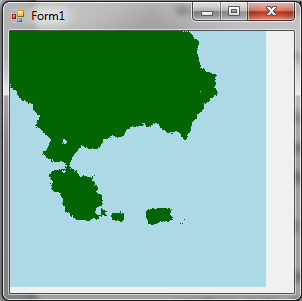
(Left click to zoom in on a point, right click to zoom out.)
However, I didn’t have anything to do with it other than spend a few hours exploring random coastlines. Which I did. But I feel like there should be some way to either make a game out of this or to make it a useful tool for sit down role players. I’m aware of a few bugs in the program, and I can think of some obvious improvements – but without a clear end point for why someone would want a map that they can endlessly zoom into, I’ve never felt like fixing it.
Which is why I’m posting this here. If anyone can suggest any uses for this, I would be highly appreciative.
Subscribe to:
Posts (Atom)